Showing posts with label Antique Collecting. Show all posts

If you are familiar with the sitcom Seinfeld (and I wonder who isn't), you might have heard about the coffee table book about coffee tables. Taking a twist on that, I'd like to mention my small, but none-the-less significant collection of books on collecting.

Like many things collected, they go through a series of stages, among them the initial notice, admiration, purchase, sometimes research (although this can come before purchase) and placement, before a thing is forgotten, or at least no longer immediately in sight of our minds-eye. This works fine for some objects, say a decanter, but not for books. A book may look nice, but can't be seen or known completely, until it is read.

This morning I picked up one of those books I have collected, but didn't yet know intimately. Purchased a year or more ago, it was about time we became more acquainted. I didn't quite know what else could be said on the subject, but the engaging pages showed me the subject is deeper, and the topic wider than I had realized. Beware ye who may find collecting tenuous.

"Your true collector does not appologize for his hobbies; he exalts their virtues," the book begins, "Necessity may occasionally compel him to resort to the camouflage of mid-interest, as when his family is not in sympathy with his pursuits; or, again, when fate has placed him in arid communion with unsympathetic associates, individuals whose personalities have developed independently of their souls, leaving them pronounced in the directions they invariably select; directions, in consequence, invariably divergent from those paths which the true collector loves to tread."

Take that! And dare you spend these moments pondering why collecting is tenuous, stop and take note of the quote from Anatole France...

People laugh at collectors, who perhaps do lay themselves open to raillery, but that is also the case with all of us when we fall in love with anything at all. We ought to envy collectors, for they brighten their days with a long and peaceable joy. perhaps what they do a little resembles the task of the children who spade up heaps of sand at the edge of the sea, laboring in vain, for all they have built will soon be overthrown, and that, no doubt, is true of collections of books and pictures also. But we need not blame the collectors for it; the fault lies in the vicissitudes of existence and brevities of life. The sea carries off the heaps of sand and the auctioneers disperse the collections; and yet there are no better pleasures than the building of heaps of sand at ten years old, of collections at sixty.

Should you want to read more or just have one lying around, it appears there are several collectible copies on Alibris.

Delicious Bookmark this on Delicious

In the current Maine Antique Digest, an article by Hollie Davis and Andrew Richmond takes an honest view of commodifying antiques.
The antiques marketplace seems to be struggling for an identity, and we have to be really careful that in that search we don't give away the heart of who we are. Antiques are beautiful, special, unique, but they're also not always practical, not always good investments, and not always the easiest option. That Chippendale chest is nice, but in many ways, it's a lot easier to go to Target.
If we regard antiques as "rent to own", as suggested by the author, the capability of retain the values makes antiques good choice of life enrichment, but that capability is far from value appreciation. True, works by some artists or some period decorative objects have gone record high, but there are others that have seen a sharp deline of demand.

There are still dealers, the number of whom still proves antiques dealing can be money-making, if not in the short run. But as individual, I think the two tenets mentioned in the article should be combined into one: Buy the best which you love and you can afford.

Delicious Bookmark this on Delicious

When you walk through the Met or the National Gallery, you might notice a number of names affixing painting labels quite frequently: Mellon, Morgan, Frick and Vanderbilt. One you don't see as often is Charles M. Schwab. Yet one can only imagine that the 75-room French Chatteau on Riverside Drive in Manhattan was filled with art. Almost as impressive, and still existing, is Schwab's 990-acre, 18 building Immergrun estate at Loretto, Pa.

Among the reasons we don't see Schwab's name often in museums is not he didn't like or collect art. A reason could be because he had a different philosophy of spreading wealth than Andrew Carnegie (Carnegie aimed to give it away before he died, Schwab aimed to spend it before he died). Schwab died bankrupt, having departed with many of his most important paintings. (While I can't verify the ones I know about are the "most important," by their caliber I can probably assume as much.)

One such painting is "Rockets and Blue Lights" by J.M.W. Turner. Schwab paid $250,000 for it in 1917. The art dealer Duveen paid $129,000 for it seven years previous. The painting is now at The Clark in Williamstown, Ma. The museum web site says it was acquired by Sterling and Francine Clark in 1932. Schwab died in 1939, so I am guessing he sold it to them.

The second painting I have found a newspaper reference for is Rembrandt's "The Accountant," also known as "St. Luke" being sold by Schwab to the Holland Museum. A New York Times article indicated the reporter reached Schwab at his Loretto, Pa estate, but Schwab declined to comment. The painting was in the Hudson-Fulton Exhibition at the Metropolitan in 1913.

Certainly there must have been many more paintings. A diagram of Schwab's Riverside Drive Mansion shows a gallery filled floor to ceiling with paintings. A 1904 article about the construction of Riverside mentions more than 100 artisans engaged in building and finishing it. One artist, Jose Villegras, completed a painting entitled "Prosperity in America." The article also mentions two gigantic bronze statues by Gerome, symbolizing metallurgic and scientific engineering.

Other references to Schwab and his art include his commissioning of Chartran to paint portraits of Admiral Dewey and his wife. The work of Paul Manship could be seen at the Loretto estate in urns embellished with an Indian carrying game from the hunt; a centaur holding his bow poised to shoot; an old man riding a donkey, and a cow scratching its nose with its hoof.

Much of Schwab's collections likely made it into museums around the country and throughout the world, but also likely passed through one or more private owners first. There is one place where you can see Schwab's name associated with items he owned, at the Southern Alleghenies Museum of Art, adjacent to his former Loretto estate, where some Tiffany lamps are held.

Schwab's wife had died in the Riverside estate, and so he no longer desired to live there and also shuttered Immergrun. "Now I have no home," he would be quoted as saying, and in the same breath felt compelled to "start life anew" in a Park Avenue apartment. Schwab himself said the site could be adapted well to an apartment house. And eight years later Riverside would be razed for an apartment building. According to a 1947 article, it took two months to remove the wood paneling, chandeliers, organ and stained glass windows before demolition could begin.

"No one wants to live in it," Schwab had said. Today some 2,000 apartments crowd the site.

Delicious Bookmark this on Delicious


Even when the art and antique markets have slowed down, there are always some surprises in an auction.

The auction offered by Thomaston Place Auction Galleries Books and Ephemera, Fine Arts and Antiques on Nov 8 has quite a few surprises. The biggest hit was a Greek marble head of a noble female. It was estimated at $2000 to $3000, but went for $19,000 as the final hammer price. (Check lot number 405 for detail.)

The marble bust has an immediate appeal with its Greek curly hair and delicate face features. The nostrils, tucked mouth corners, rounded chin and sensual lips show a certain degree of realism. In particular, the neck of the bust was sculpted with neck lines to indicate some slack skins. But her slightly upward face displays a mixture of purity and reserve on a convincing youthful face. Looking at her stares which are straightforward, but not protruding, I feel she is almost ready for communication!

The bust was from James P. Baxter's collection in 1894, so it is free of trouble from UNESCO 1970 Convention. James P. Baxter was the first president of the Portland Society of Arts. James was an avid collector who owned a Marie Antoinette sideboard. Like other early collectors, Mr. Baxter was also a scholar who wrote the book "The Pioneers of New France in New England". It is possible that how the beautiful marble bust came to a home in Portland, ME one hundred years ago is not known as the early practices of antiquity acquisition mostly ignored written records, however, knowing that it was once cherished by a famous collector adds another layer of joys of collecting and appreciation.


Delicious Bookmark this on Delicious


It was a beautiful day for a trip North. And Eric and I took the suggestion from a friend and hopped onto the Metro North. Just 72 minutes away from Grand Central, Cold Spring NY feels so laid back as if life has not changed that much since the 19th century.

Hudson River is much wider than what I had expected. The cliffs are high and mountains layered. On the train, I watched the grand panorama in awe not just because of its natural beauty but also its history with Thomas Cole and Edwin Church, both of whose houses have been preserved nowadays.

Along the Main street of Cold Spring, we explored most of the antique stores. Except one high-end stores with meticulous Mahogany veneered pier tables and side boards, other stores are fun to sift through. An old women told me how to tell whether a cloisonne was made in China or Japan. It looked fairly old, then I saw in the same locked cabinet a very amateurishly carved alabaster statue of Nefertiti, probably from a souvenir market store. I have seen the picture of the famous statue now residing in Berlin, well simply put the alabaster statue definitely cannot justify her beauty. To make things worse, the old lady said that she had another one and pointing up to the top of a cabinet behind her. This Nefertiti head statue turned out to be black color , more like a head of the female mannequin from Macy's.

Eric and I picked the restaurant at the corner of Rt 9D and Rt 301, which is housed in a historical building dated in 1830's. I had the biggest burger in my life and nevertheless I finished it. In the restaurant, we met people from Boston. The owner of the restaurant spend quite some time to explain why he thought the building was built in 1850's, which was contradictory to what is said in the guide brochure.

For more about the history of Cold Spring, visit here.


Delicious Bookmark this on Delicious

I went inside the visible storage rooms last week for the Small Wonders exhibition in Brooklyn Museum. It took the place of the Japanese woodblock prints and the American artworks they influenced. It is an interesting idea that inside the Luce Center part of the visible storage will be devoted to temporary exhibitions.

Among these small wonders, there are objects in textiles, porcelains, flatware and ceramic tiles. Nudged by Eric, I noticed two objects came from the Ohio Valley where Eric and I had visited extensively in the past. One tile is from Zanesville, Ohio. Another tile was made in Beaver Falls, Penna. I immediately recalled vividly our visits to these two small places.

The trip to Zanesville was to fulfill the mission of finding a bird bath in the yard. Zanesville's historical fame and association with glass and ceramics could be seen through the antique malls lined along route 22. Another interesting observation that I have made was the abundant books by Thomas Mann published in 20's and 30's by Alfred Knopf. Not accidentally this was a period that many famous German exiled immigrates such as Mann or Schoenberg found their followers in the US. Their high culture root was praised and fostered all over the country. In particular Mann was regarded as a heritage culture authority and a champion of liberal and democratic values.

It was a smoldering day and we ended up buying a chunk concrete bird bath featuring a group of chubby angles which we sold later at half of the price before the move to Brooklyn. But the surprise of that trip came from the stop at Cambridge, Ohio where we found a nice art gallery in which we bought a painting by a local senior painter and a used-book store where I found the first edition of In Cold Blood for 15 dollars.

Beaver Falls is smaller. It is one of those dying river towns-- the scenery painted by George Hetzel more than 100 years ago, given away to mills and factories which subsequently died out with the declination of manufacturing sectors. When my ex-classmate moved from State College to Beaver Falls, they were told that they made the history to become the first Chinese residents of the town. "That grocery store owners took particular pride to see the influx of 'ALIEN' faces, but I am not sure he was friendly." My friend's father-in-law told me.

I have seen quite some good porcelains made in Beaver Falls. If I am correct, some of those president plates displayed in Hoyt Institute in New Castle, Penna were made in Beaver Falls. In fact, a lot of restaurants in western Pennsylvania had been using their porcelains for decades.

Besides the fact that Kittanning clay was used in the manufacturing process, I knew nothing about this particular porcelain made in Beaver Falls. Zanesville was more remote since I didn't have the chance to visit its downtown area. But they have laid such a deep impression that the images of the towns are just as clear as the figures on those tiles. In both cases, the objects remind me the flourish of the small river towns during the industrialization period. They once prospered, wealth collected, mansions or bigger houses built, even though what I have seen in the past does not necessarily prove that, or even worse shows the opposite.

There has always something special about those visits to these river towns, especially to someone like me, born and raised outside of US. It was a vivid revelation of American history that would never be put in any Chinese history textbook, yet those white old antique dealers sitting still in either once-to-be warehouses or Victorian family houses are quintessentially American. When I look back, those antique trips seem so remote in the lifestyle of New York where every minute of living must be justified by doing something profitable. The trips of antique shopping had a much slower pace than that that I took stepping out of the subway. Nine out of ten times the stores contained more junk (or in a better phrasing collectibles) than real antiques and 9.5 out of 10 times we ended up not buying, but driving around. But soaking in the stagnant air and surrounded by piles of stuff in an antique mall, one's life became meaningful by seeking and preserving the meaning of the past: The joy came from seeking while the happiness of preserving came like an unexpected trophy.

Delicious Bookmark this on Delicious

On my first visit to the antiques strip along Atlantic Ave in Brooklyn, I noticed almost all stores have their websites, except probably Horseman, which is stuffed with mid-century items scattered over five floors.

In the "Incurable Collector Antiques" store, a Columbia University student majoring in journalism was interviewing the owner when I was there. The owner stated that the future of the antiques business is online. With a click of a mouse, more people can have access to the inventory.

Certainly the cost of building a website or like the owner of the Incurable Collector Antiques to use some online services is relatively small. And it for sure reaches out the potential customers. Through website more customers may get to know such stores and come to visit the stores. (Not accidentally, I found out these places by typing "antique strip brooklyn" in google.) Furthermore, some transaction may happen directly online. The owner of Repeat Performance Antiques is now using GoAntiques to sell stuff. And David Marshall, the owner of the Antique Rooms, now owns a second website (http://www.americanandenglishantiques.com/) which utilizes the new flash technology to create online portfolios. Thirdly, with the sharp increase, a lot of stores cannot keep business at where they are now; but an online store makes the choice of location less important.

Still, will the internet change the downturn of the antiques business? I have my doubts.

The first characteristic feature of the antique objects is that they are unique to certain degree. Hardly two items are exactly the same. Some differences are quite subtle such as the splat of a chair or the shade of a lamp. The antique shopping is exciting in that one is personally hand picking stuff that interests his eyes, hands and mind. The scrutinization with the aid of touch and look both strengthens one's perception and cognition and weaken one's objectivity at the same time. Online pictures and description lacks such a warmth and humanity of real antique shopping and flatten the objects into remote and mysterious merchandise.

This is especially true for stores which feature high end antique objects. Will one buy a sofa attributed to Anthony Quevelle without even examining it in person? The trust mechanism that has been built solid in online giants such as eBay or Amazon Market does not exist in workshop-style antique stores. Plus the inborn fragile or bulky character of antiques objects makes shipping troublesome or even cost prohibitive.

Secondly, antiques business is having a hard time regardless to the boom of Internet shopping. High-end antiques can be immune to the market trend (including stock market), but medium ranged objects are closely related to the house market. The money strain hit the regular buyers hard that the pleasure of finding something unexpected and surprising on weekend antique shopping comes with a sting on the hand holding the wallet. (New Yorkers in particular face both the budget constraint and the space limitation. ) With the house market slows down, stalls and renegades, and the food, gas, rents keep rising, the painful struggling period of antique business will last for quite a while.

Lastly, the complains and groans about the change of tastes, in my point of view, may only be partially true. The trends have always worked in a swing fashion. The young generation has witnessed the most fast growth of information in history. They are the masters of finding and digesting what is available from the past. The fact that they are now buying funky furniture does not necessarily mean that they won't fall in love with victorian antiques in future. Money, time and space, all these factors refrain them from venturing into something that can only be fully appreciated when you begin to get involved with a fairly thick check book. But there is a reason, I believe, for those antiques objects being sought after and kept pristine for such a long time. They encompass the characters of uniqueness and universality, the values of humanity, history, religion, symbolism and aestheticism. They may be now hidden in the dusty nooks of some shops, nevertheless, they shine in front of the keen eyes, which fortunately always exist.

Delicious Bookmark this on Delicious

Compulsive hoarding can be defined as an obsessive-compulsive disorder. That doesn’t mean that all hoarding is a disorder, however. Moreover, there are distinctions to be drawn between “hoarding,” accumulating and the more positively connoted “collecting.”

These differentiations were among the issues discussed during a recent panel discussion sponsored by the Center for Humanities at the Graduate Center of the City University of New York.

Most of us never think much about why we collect or accumulate things, we just do. Wouldn’t you know, however, there’s something called “thing theory” and there are lots of people, five on this panel alone, collecting theories on why we collect things.

From Wikipedia, Thing theory is a branch of critical theory that focuses on the role of things in literature and culture. It borrows from Heidegger's distinction between objects and things, whereby an object becomes a thing when it is somehow made to stand out against the backdrop of the world it exists in.

Collections of these things range across a broad spectrum and can be anything from belly button lint to paintings. One of the first quotes of the evening may not fully explain the why of the collecting, but can give some sense of reason for it. “How can you fault someone for figuring out how to be happy.”

In listening to the talks, I couldn’t help but wonder whether collecting and accumulating were somehow different. I recalled a chapter in book, a copy of which I initially notices in a display case in the Winterthur Museum and later purchased, The Charm of the Antique.

The book, published in 1914, explores a number of charms including the charm of acquisition, the charm of the thing you didn’t get, the charm of specializing, the charm of the unexpected and finally the charm of posession. It’s this final charm I suspect the panelists would find most interesting. It touches on the differentiation between hoarding and collecting and the collector who hoardes.

The collector who possesses to hoard has always existed and will always exist. “What toil did honest Curio take, what strict inquiries did he make”—thus sang Matt Prior many a generation ago, for collecting seems to bethe satisfyingof a natural instinct and has always had a vogue; and Prior goes on: “’Tis found, oan O his happy lot! ‘Tis bought, locked up, and lies forgot.”

In the chapter titled “The Charm of the Thing You didn’t Get,” the author touches more on the topic.


There are times when you see an article, and admire its charm, but do not acquire it because you really have enough of that particular kind of thing. Of what use is another tall clock or sideboard if you really have no need for it! There are, indeed, some enthusiasts who cannot resist the appeal of another and another so long as they have the space to crowd them. But that is accumulating rather than collecting; and between accumulating and collecting there is a difference. The lure of mere accumulation is strong, because of its being based on a very strong love for the old, but the collector should realise that not only does he keep the treasure from other collectors without any real advantage to himself, but that by crowding and cluttering his house he defeats the main purpose of collecting and home-making, which is, having the house look its very best—which it cannot do if antiques are jammed into every corner—or even stored like cordwood, as we know of forty four-post beds being kept!


The book then describes an aspect of collecting I am recently familiar with. Having packed your own home, you continually lend things to friends and family to keep until you have a bigger house (or send them to storage).


It is exasperating to find people clinging to antiques with no appreciation of what they really are but with stubborn determination to hold them because other people would like to have them; but even in such cases the charm of the things themselves is felt by the collector who doesn’t get them from the dog in the manger.


When panelist Judith Pascoe, Professor of English at the University of Iowa, passed around a scrap book with samples of stitching patterns some person from the past had meticulously assembled, one attendee came close to scolding her ascing about the lines between collecting and preservation. Pascoe replied that she had herself dealt with this issue and made a consious decision to pass around the real object being discussed because, while care and preservation was important, if it can’t be used and learned from by living people, “what good is it?”

One of the reasons for collecting described by the panel is the immortalization of the self. This is undoubtedly the case for many of the big collectors of art, Like Henry Clay Frick in the Gilded Age and Alice Walton today. For the regular collector, the book touches on what to do with the furniture for the future and suggests that giving it to museums is often a misguided effort. “Merely to throw ones things at the nearest museum may be just as foolish as to make a bonfire of them; but, on the other hand, there is no finer destination than an excellent museum that needs them.” Founding your own museum of course is a different issue entirely.

Yet another issue touched on was the value in a thing itself vs. the value of the provenance. That brought to mind a recent old masters exhibit at the Met arranged not chronologically or by artist, but by who had donated the paintings.

I’ve personally started several collections over the years, and in most cases I have disposed of those collections only to start collecting something else. Most recently it’s stereoview cards from a particular photographer, and secondarily glass slides. Sometimes we collect things for what they symbolize. One participant spoke of days when gays and lesbians had to be more discreet and used object and patterns in their homes to define express themselves. It turns out there’s someone working on a book about this evry subject.

At one point I was collecting postcards, mostly of well-known buildings like Grand Central Terminal and the Empire State Building. My friend commented that I should seek out rare cards, not these common ones. To me rare cards weren't interesting. These common cards symbolized New York, the place I knew I wanted to one day live. Today the cards are in storage, and I am here pondering my long-ago reason for their purchase.

Delicious Bookmark this on Delicious


Have you ever imagined what it would be like to travel with a piano across the Alleghenies before the days of trucks, railroads or even canals? Yet an ad appearing in the Post-Gazette of July 20, 1813 suggests someone did just that.

The advertisement of 1813, published some sixteen years before the completion of the canal, informs readers only that a fine-toned piano forte was for sale. A maker is not identified and it is unknown where the instrument was manufactured. It could be that the piano traveled, somehow, from Baltimore or Philadelphia, but it could also have been made at home.

With advertisements appearing as early as 1814, Charles Rosenbaum was one known maker, and he seems to have worked in the city for five years. The quality of his work suggests a degree of cultural sophistication unexpected in a frontier town, and reinforces the complexities and cost of importing goods from the east.

Yet if Rosenbaum was the first manufacturer of piano fortes in Pittsburgh and he set up shop in 1814, then the piano advertised in 1813 could not have been made by him. If it had journeyed across the Alleghenies, it wouldn’t be the only piano to do so. Family history tells us that a Philadelphia-built piano forte owned by General Richard Butler was given to his daughter Mary in 1791, just before leaving on a fateful military expedition. In 1791, the piano forte somehow made it over Indian trails from Philadelphia to what is now Lawrenceville. It’s now located in the Heinz History Center.

(shown is a New York made piano forte now at the Westmoreland Museum of Art)

Delicious Bookmark this on Delicious


The antique shopping trip to Canonsburg was on a warm winter Sunday afternoon. We’ve stopped at almost every antique store there and decided to finish the last one which was in the same block with the other two we’d just visited. The scale of antique stores in Canonsburg outweighs the size of the town because “it is cheaper to open a store here.”


The store looked tasteless with a special bargain room open on Sunday. The owner, a typical suburban American woman in her middle age greeted us from her chair surrounded by all different stuff.


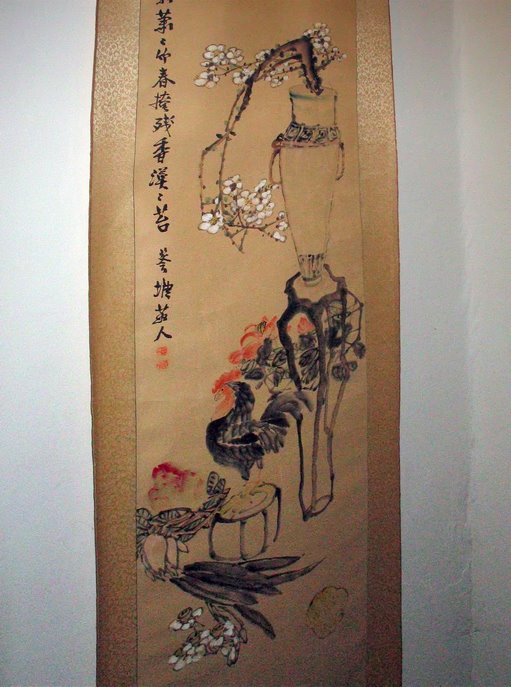
It almost turned out to be another futile excursion (we hadn’t got anything except tired legs) before I spotted a Chinese paining of plum.


It was damaged: The right corner of the scroll was broken and that was the first thing I noticed. Being an impatient non-serious antique shopper, I usually only show my interest in those “intact”. But after Eric joined me, I was attracted by the poem:


寒依疏影萧萧竹, 春掩残香漠漠苔。

I didn’t know who wrote the poem and I was not sure whether I read it correctly from the handwriting. Actually even worse, I haven’t read any poem or book in Chinese since I came to US. But the subtlety and delicacy of the Chinese words brought out my memory of the happy time spent in reading poems of Tang Dynasty. Those words by being seen and being pronounced, suddenly became magic and I even thought I could smell the subdued fragrance from plum.


“It was a 1950’s work and that’s all I know about it.” The owner told me. Then I volunteered to translate the poem into English, which I definitely don’t have the skill but luckily am better than anyone else in the room.


“Winter accompanies your lonely shadow echoing the shuddering bamboos, spring tries in vain to hide the remains of your light fragrant.”


After carefully examining the scroll, I noticed that there was some note written on the back of the bottom scroll. It read “To Du Mei at the 1960’s QingBei Medical School’s class reunion party on April 7, 1975”. Well, it was not a 1950’s work, but definitely older than I!


The painting features plum in the top half part and a rooster at the bottom. Eric pointed out there was such a discrepancy between the two parts that he felt it was like painted by two different people. I was still fascinated by the fact that my aweful translation skill had been appreciated by an unknown antique store owner, but tried to agree with him to make the conservation going.


“It was dedicated to a girl called Du Mei. And in Chinese, Mei has the same pronunciation of plum. Maybe there is something here.”


I told Eric.Eric was curious too about the painter’s dedication note and decided to give an offer. The owner, who appreciated my effort of translation and my correction on the date, accepted the low offer (only half of the original price) immediately and that made our day!


When we got home, Eric immediately fixed the broken scroll at the bottom and hung it on the wall where no cat can touch.


Later, I found out that Qing Bei Medical School is not in China, but in South Korea. No wonder that the scroll material has Korean words on it.


How did a painting by a Chinese medical school student in South Korea finally find its home in Pittsburgh? No one could explain. And is Du Mei a Korean girl or Chinese? Is there any love story behind it? Is there a happy ending? I sent an email to that medical school and didn’t get any reply. I guess it is weird for the school staff to read an email from someone who wants to know the love story of an International student 40 years ago. Probably I can never answer those questions. But the painting hangs there with its decency and respect, enjoying my crutiny and scorning my effort to discover its own story.

Delicious Bookmark this on Delicious

Antique dealers come and go. Under normal conditions, it is not surprising to see big red “For Sale” sign in front of some small antique shops. But recently, the antique business, at least at the low end, has seen a quick downfall as some big antique malls have been shuttered locally and elsewhere.

Why has antique become so hard to sell? Here are some of my theories.

1. eBay

The efficiency and volume of the eBay marketplace has changed antique business fundamentally. No where else can one find items from affordable to high quality so easily.

In particular, antique business has lost a selling point when uniqueness fades away from a single search click. Things that seem rare in the stores may surprise you with their abundance online. To make things worse, the varied prices makes one wonder what the true value is.

2. Downsizing trend

The pace of life has accelerated and Americans are moving constantly. The change in the life style makes disposability and affordability more important than ever. Downsizing of living space is happening not only for young generations, but also for boomers who are gradually retiring. Collecting is inevitably affected.

3. Changes in antique style

Collecting is almost an instinct, sometimes an impulse. The driving force of antiques collecting is sometimes a memory of the past that people associate or treasure. The collective memory of today doesn't stretch back much beyond the 1920s, an era when mass-production came into its full being. Beyond 1920, affordable design was more important than uniquely crafted objects by an artisan. Collecting works before this period requires substantial research and education before the buying process, which is also quite different, can begin. Unfortunately in 60’s, 70’s and even 80’s American has entered the era of mass production and the craftsmanship associated with jewelry names is hard to find; thus antique business of that period can be equally hard.

4. Declination in quality

The co-op feature of antique malls eventually hurts dealers. From economics point of view, it is a “common” where regulation is missing. Dealers know that if everyone brings lots of collectible and reproduction, the mall won’t work; but if only I (one dealer) do that, it won’t hurt when you average the damage of impression by 100-or-so dealers. There are no incentives to strive for excellence.

5. Accessibility of Auctions

Once upon a time, auctions were primarily for dealers. Now, through the Internet, anyone can buy at auction.

6. Decline of the Antique Dealer

A move from Main Street to the antique mall has meant that the antique dealer, whose function was not just to sell antiques, but to educate the buyer, has become absent from the process. Uninformed buyers have sometimes mis-spent their time, money and energy collecting somethings that weren't quite what they hoped they were.

Overall, in the long run the antique business may endure some tough period. No matter what period or what style, there are always some people who shop for the top quality. But the success of most of antique business relies on the majority shopping of the medium range. The young generation, growing up with Xbox and iPOD, think and behave and shop differently. With the overwhelming information from youtube to online chatting, it is rare to find time to study the past style which defines what they are not.

Changes in fashions do swing with the pendulum. But antiques, a visible form of the past, never goes right back to where it was.

Delicious Bookmark this on Delicious

(Photo: On display in Philadelphia in 1876 was George Pullman's Corliss engine, later used to run a factory in Pullman, Il)

The "Beaux-Arts boys," as Burnham called them, remained in Chicago for a week and then returned in a private car at the end of February with their completed sketches. Unrolling them on the walls of Burnham's library, a blazing fire in the heath, they explained their ideas to the fair's grounds and buildings committee. As the winter afternoon drew to a close, the sculptor Augustus Saint-Gaudens, who had been brought to Chicago to advise on artistic matters, approached Burnham, took him by the hands and declared: "Look here, old fellow, do you realize that this is the greatest meeting of artists since the Fifteenth Century." Donald Miller, City of the Century


click here for: WORLD'S FAIR POSTERS

It’s easy to imagine that our world today is constantly confronted with things that are “bigger” and “more” than in years past. There are several areas where we can look back and know with a good amount of certainty that they’re unlikely to rival the past in the foreseeable future. One such area is passenger train service, and the other area is expositions.

The idea of an exposition is something that’s somewhat lost in an age of passive entertainment and mass-media. In fact, its hard to imagine one million people ever attending a single event, let alone having an active interest in human progress, art and culture (sorry to be realistically cynical). Imagining that twenty-seven million people attended the World’s Columbian Exposition in 1893 would seem beyond comprehension.

Consider that on any given day in 2006 a little more than 200,000 people passed through Chicago’s O’Hare airport. Fewer than two million people lived in Chicago in 1893. The 1893 U.S. population was about twice the number of Exposition attendees. The 1996 Atlanta Olympics ended with 3.8 million tickets sold.

Chicago’s 1893 Exposition was perhaps the most influential of the great American expositions, and because of the large number of attendees, one of the easiest to collect memorabilia from. Memorabilia can range from books to tickets, prints to stereo-view cards, maps and more. A good place to start might be ebay #290140071370, a book of official views from the exposition.

Of course the earlier the exposition, the more difficult it becomes to collect memorabilia. Before Chicago, Philadelphia was host to the first American exposition, an event attended by some ten million people in 1876. I was recently happy to purchase on ebay a small Liberty Bell-shaped decanter from the 1876 Exposition. Don’t confuse 1876 items with “fifty years later” event in 1926.

The 1901 Buffalo Pan-American Exposition is another to look for. President William McKinley was assassinated at this exposition. Saint Louis held one in 1904, and San Francisco in 1915, an event celebrating the completion of the Panama Canal. An interesting item currently available for the Buffalo is a short-line railroad timetable promoting the event (ebay item 170132361023). Like the 1893 Chicago event, which helped the city recover from the great fire, the 1915 San Francisco event helped breath new life into the city following the 1906 earthquake.

Delicious Bookmark this on Delicious


I hadn’t known what a Fraktur was until I attended a lecture at the Westmoreland Museum of American Art in Greensburg, Pa last evening. I had seen Frakturs before—a decorated document created by German settlers named for the “fractured” lettering. The exhibit is well-thought out and displayed first by region, then by chronology. The Frakturs are displayed with two Pennsylvania clocks, both which contain symbolic inlay also found in many Frakturs.

Also on display is a collection of painted Pennsylvania furniture, much of which was made outside of Johnstown, PA in a place called Soap Hollow. Apparently the most identifiable mark on Soap Hollow furniture (besides the name of the maker painted squarely on the front) is the wave-fold backsplash. In all honesty Frakturs and painted furniture would not be the first thing to catch my eye at an antique show, but I left with a new found appreciation for the furniture. Remarkably some three hundred documented pieces of Soap Hollow furniture exist today, one chest which brought $115,000 at Garth’s auction recently. Impressive at a time when a sophisticated Empire sideboard might not fetch $2,000 at auction.

The painted furniture, like the Frakturs may not be sophisticated or have been created by well-trained artisans. It does have a certain direct connection to the people who made and owned it, however and that then gives it a more direct line into the past. There’s quite a bit to learn from it, stories about the owners, the occasion for its making and its makers. There must have been a couple hundred people from several states who came for the lecture at the Westmoreland, and I think perhaps these are the qualities of Pennsylvania folk art that make it so attractive.

The collector who gave the lecture on the Frakturs explained that after buying his first at an auction, a few hammers later a Fraktur for the sister came up and so on until we arrived last night at the Westmoreland show. How could you not want to keep the family together?

There are some other upcoming events regarding Pennsylvania Folk Art at the museum. Click the link in the right menu bar and check 'em out.

Delicious Bookmark this on Delicious

Larchmere is known as Cleveland's Antique District (also Lorain Avenue near downtown on the West Side). If you've never visited, consider heading North for the Larchmere Flea Market and Festival June 30, 11-5. MORE INFORMATION

Delicious Bookmark this on Delicious


No, it is not to symbolize wealth. True, money is indispensable for any art and antique collection. But that is only a necessity. In fact almost every hobby approached with certain degree of obsession, burns a hole in the pockets.

No, it is not for decorative purpose alone. Art has a role greater than mere decoration. IKEA posters can certainly complete the task of home decoration. Decoration is pleasing, but art is elevating.
However, art collecting is not entirely for edification either. Fundamentally there is a huge difference between the pleasure that comes from looking at art and that which derives from ownership. The edification, the happiness of viewing the beauty can be and have been fulfilled by visiting museums around the world, many of which are free to the public.

Here is what Tobias Meyer said:


Owning art, unlike seeing it in a museum, is a very primal pleasure.

Having it there, close to you, something that you associate with great beauty or great emotional expression, something that you associate with a soul, or with status--owning it gives you another status -- is very important.

It's a very intense feeling for many people.

Delicious Bookmark this on Delicious


Antique collecting is not as easy as going to a furniture store and picking out a new sofa. While many will purchase old furniture because they need one thing or another, others look for old furniture that has some value beyond its functionality.

If you’re looking at furniture for these purposes, chances are that you can be identified as an antique collector. If not, you certainly have the potential to be.

If you know you like furniture for more than its functionality, you may still be confronted with what exactly to collect. Visiting one of the antique malls may seem to be a good place to start. In reality for the beginner a large antique mall may be the worst place to start. By U.S. Custom law definition an antique must be at least a century old. There may be some items that can meet this criteria in an antique mall, but its mixed with things not half as old.

If you like to look at antiques like art, you might also want to concentrate on furniture and other items made by a craftsman rather than those produced in a factory. That even becomes more difficult as the first piece of furniture to leave a factory in the United States did so more than a century ago. Beyond its design, much of the furniture even from Victorian times was factory made. Beyond its design it can’t be far admired for the art that went into its making.

If you are one who admires old furniture, it may be because you live in an old house. It’s easy to like an old house. You can find lots of people living in old houses, yet inside there are plain white walls and furniture from a department store. Old houses are even more fun and interesting with old furniture in them. You may want to find antiques that are appropriate to the time period when the house was built. If this is your motivation for collecting antiques, it may matter less whether or not they were individually crafted for factory produced. Still, before you go shopping and make a big purchase you could later regret, you’ll want to get a better idea of what style of furniture would have been in the house when it was new.

It’s not my personal intention to strictly adhere to a period décor, however. I enjoy antiques more for their artistic value and would miss the soft cushions as soon as I traded a modern sofa for an antique one. While some collectors like to have a home furnished almost entirely in period antiques, its people like me who lead some antiques to being less valuable. One of the main contributors to the value of an antique is whether or not it has a modern purpose. An antique instrument or chair potty or in some instances seating furniture and bedding is not going to be in as much demand as a sideboard, table or bookcase.

Some collectors look at antiques from an investment standpoint. The way I see it if you buy something at a department store, its value can greatly diminished as soon as it leaves the store. If you carefully buy an antique, the chances are good it will keep its value or increase in value. Of course that’s not always the case as the market for certain styles of antiques fluctuates similar to the art market. I should also mention that some things you might bring home from an antique mall may cost you later to dispose of. If your goal is to buy antiques as an investment, buy the best you can afford and seek lots of advice beforehand.

You may be asking where to find the good antiques and how to learn which ones they are. The best way is probably to befriend a reputable dealer. Dealers love to learn about what you collect and are usually happy to help you understand an item and justify its asking price. One of the most famous antique dealers, Israel Sack, kept a large file of every piece of furniture sold through his shop and allowed his customers access to the file for reference.

Another way to start is to begin to watch auctions. The better auction houses have an expert make an assessment of the age and condition of a piece of furniture. They also provide an estimated hammer price. It may be better to watch auctions for a while before bidding to get a sense of what items are desirable and how much they should sell for. If you decide to bid, remember there is usually a 15 -20 percent fee on top of the hammer price known as the buyer’s premium. If an auction is within a reasonable distance its also advisable to go to the preview to inspect the items.

Another great way to learn about antiques and meet dealers is to attend an antiques show. There are at least two held in Pittsburgh each year, one in Sewickley and one in Fox Chapel. There are many other shows within driving distance. There’s usually an admission fee and the shows usually benefit a charity or non-profit organization.

What about ebay? Like the large antique mall, ebay may be better left for the experienced collector. Many pieces of furniture have been reproduced several times since the period in which the style originated. This is especially true for earlier styles. Experienced dealers and collectors usually find it easy to spot a reproduction, but it’s not always absolutely apparent. More, especially when you get into the more expensive furniture it may have been deliberately faked. It wouldn’t be the first time a piece has been deliberately aged and hidden in a corner for someone else to “discover.”

Subscribing to Maine Antiques Digest and Antiques Magazine are also great ways to begin to learn about antiques and collecting. Maine Antiques Digest is especially useful in establishing what price items can bring.

I should add finally that some antique malls restrict the quality of the merchandise offered there and the dealers are knowledgeable. Here are some places to find antiques in Pittsburgh:

Malls:

Antique Center of Strabane
2510 Washington Rd.- Route 19 South
724-745-8445

Independent Dealers:

Mark Evers Antiques and Fine Art
4951 Centre Avenue
Pittsburgh, PA 15213
412-688-9990

Merryvale Antiques
5867 Ellsworth Avenue
Pittsburgh, PA 15232
412-661-3200

Gallery in the Square
5850 Ellsworth Ave.
Pittsburgh, PA 15232
412-361-3808

Delicious Bookmark this on Delicious


Most of time, it is a delight to talk with art and antique dealers, who take quick note of where your eyes land and if receiving a positive comment, their eyes light up like fire.

Passion is always a necessity for the success of any career. For art and antiques dealers, it is no doubt that one of the driven forces would be the passion for finding unnoticed value. Searching treasures in numerous antique fairs and malls is no easier than finding a needle in a hay stack, yet almost every dealer will tell you such a story, even though it may have happened 20 years ago or the great treasure still sits in the garage waiting for the right buyer.

Unfortunately, that is not enough. What a miserable life it is if one does not enjoy or love the art or antique that he or she deals in.

One of the antique dealers that I know told me that the market for empire furniture is so stale that he totally got rid of it. To make his efforts honorable, he told me he once ripped off all the mahogany veneer and painted a mahogany sideboard white to sell it. I was stunned, even though I was kind of prepared for this kind of eccentricity from the exotic and unusual merchandise in his booth.

Art and antiques follow trends. Most of the trends can be explained within social and economic contexts, yet some happens unexpected. The market bubble for Impressionism, and contemporary art have not seen signs of a downturn, partly due to blazing desires of some deep pocketed collectors like Paul Allen; Empire furniture, on the other hand, whose grandeur style sometimes overwhelms modern sensibilities, is not enjoying high demand.

Yet just like stock market, it will fluctuate, although the change in some styles or periods may take a long time. Destroying the veneer may bring a handsome sum of money in a short term, but could really hurt business when the shimmering dark red mahogany begins to reclaim its proud wall in the dining room.

It has been well said: buy the works that you like, not the works that you think may be profitable. After all, it is the beauty where the hearts is.

Delicious Bookmark this on Delicious