Showing posts with label Egyptian arts. Show all posts


There was a moment of silence when my friend asked me why Egyptian art? Why a people 5,000 years ago whose language obsolete?

Nothing is more striking than looking at this picture of head of Ramsess II lying on the rubbles. It is sad, mysterious, and marvelous despite of the damage.

If we obliterate the future and the past, the present moment stands in empty space, outside life and its chronology, outside time and independent of it.

Delicious Bookmark this on Delicious

On the bus back from Montclair, NJ to the city, I happened to have a glimpse at one of the advertisement page on the current issue of “Art and Antique” magazine. What is featured is something unusual: an almost life-size bronze statue in the 22nd Dynasty.

A lot of residence-cities of Third Intermediate have suffered almost total destruction or lie beneath Delta silt, therefore there are not a lot material remains from the palace site. (This statues are almost certain from some temple.) But Libyans, more advanced than Egyptians with respect to smith works, brought their special skills in bronze, silver and gold. Therefore, if any object survives, they could show considerable artistic merits.

The 22nd Dynasty was marked by those pharaohs with foreign names: Shoshenq or Osorkon. But they were not the Libyan described in the wall relief of the New Kingdom with the stupid side locks with beards; instead they adopted the Egyptian way naturally since they had been living in Egypt since 19th Dynasty.

In the ad, the identity of the bronze statue is a Divine Consort of Amum, a religious official post usually held by a female member of royal family. I have seen a picture of Queen Karomama from Louvre. The dress and the short wig are similar to this statue and appropriate to the period, but the details of the floral collar and the embroidered gown on the queen are far more stunning while this one is quite plain. As usual, the sistra that she is supposed to hold in both hands are missing.

I wish I can know more about this particular piece for sale. First, her feet are just shoulder-width apart. Most of the standing gods or goddesses that I have seen have left foot ahead. Secondly, if she was a Divine Consort of Amum, then there must be some records or traces because she is a wife of the god and most likely a member from royal family. The large scale size and her inlaid eyes and gold necklace indicate this is not meant for some commoner. But the statue is only dated to the dynasty, not to some specific king. And lastly, her face features, to me, actually look more like Kushite than Libyan. And it is known that Kushites kept the established Divine Consort practice. Is she a kushite?

I cannot find this particular object on the gallery’s website. But they have great inventory of antiquities. The website is www.royalathena.com.

Delicious Bookmark this on Delicious

For convenience, read part 1 and part 2.
There is little known about the bird lady from the archeological point of view, nor would one infer much conclusions from a tried observation. When Henri de Morgan in the winter of 1906-1907 found the Terra-cotta statue from a tomb at El Ma'mariya, he did not record much about the excavation procedure, nor the tomb specifics. So There is even no consensus on what we should call her. Bird lady is possibly a pure invention our of one's imagination, but the name fits her well, or should we say in another way that the name does not matter here?

So far, I have heard three different versons of the possible meaning/purpose of the figurine. 

Ann Russmann, the curator, linked her with a pottery vessel from Naqada II period, which also bears a female figure whose arms sweep up like a bird. Because of her prominent proportion compared to the male figure next to her, Ann concluded she must be a goddess although the function is unclear. But the larger-than usual head of the female painted on the vessel is a clear statement that she has blossoming hairs. The bead head of the statue, on the contrary, with some rezin painted in black in a suggestive manner, looks more like from a bird.

Yekaterina Barbash, another curator of Egyptian Art compared her gesture with the funeral mourning convention. It is natural to think a mourner figurine would find her niche in a tomb. But from the available paintings, mourning women ususally pull their hands close in front of the faces or above the heads. In neither position will one see the arms wide open like a bird ready to fly.

The third version is from the book "The Egyptians" by Cyril Aldred published by Thames & Hudson (ISBN 0-500-28036-3). Cyril takes the note that she is wearing a long white skirt as the evidence of dancing. He even suggested the dance may be inspired by the bird-mating since the arms have an unusual upward mometum. With this assumption, he suggested that the fingurine may have magic fertility functions.

I have found none of the inferences totally convincing, nevertheless the figurine is and deserves to be the highlight among all wonderful Egyptian collections in the Brooklyn Museum. 

Unlike the later dynastic Egyptian period when statues are as strict as canonical paintings, the early artworks is from minds of great freedom. In my mind, her slim waist, wide buttock, bead head and peg-like legs connect directly to the spirit of Henry Moore where the rhythms of curves are as expressive and informative as the objects themselves. The arms that intrigues and ponders so many scholars and visitors break the abstract austerity with an unusual curve: bold, dynamic yet still elegant. Could she be just carrying some burden for the deceased? Or maybe the upward arms is a symbol of resurrection? I wondered.

Such artworks may seem too primitive for some visitors who praise the French academy or Roman statues. But the great art always bears some sort of unsolvable mystery as charming as Mona Lisa's smile. It brings unexpected rewards to those who frequent observe them with fresh eyes. And those who have done that enjoy the same degree of happiness as the kids treasure in a magic land. For example, although breasts are made crude and possibly modeled after the body part was completed, the highest point of the figurine -- the fingers -- are beautifully indicated with carefully aligned straight lines. Then as one looks at them and may even try to imitate the movement, here comes the surprise: The thumbs, which are supposed to be in the back in reality when arms reach high in the air, are curiously modeled in the front. Could it a result of ignorance or bluntness of the artist? Or maybe he meant to show us the thumbs in the front view? I don't know.

More than 5000 years have passed, standing quiet in a glass case, its unconventionality still challenges what we see and push us back to re-examine the seemingly gap between avant guard and antiquity.

Delicious Bookmark this on Delicious


When Herodotus visited Egypt in 5BC, he left one of the most remarkable comments on Egyptian art:
Concerning Egypt itself I shall extend my remarks to a great length, because there is no country that possesses so many wonders, nor any that has such a number of works which defy description.
He would have had to live another 2300 years for the discovery of Amarna culture, even long if he had wanted to see the golden mask of Tutankhamum and his buried treasure. But on the other hand, what he saw was still an ancient Egypt, a nation of antiquity in si tu. Coming from the Mediterranean Greek culture , he found only particularity in Egypt: the strange and alien nature contrasting the grand scale and numerous quantity of monuments and temples.

He also commented that the Egyptians were the most religious nation than any other he had known. To this, I have my own reservation. Although there were no single god that Egyptians worship and polytheism can be both used to describe Greeks and Egyptians, the roles of religions in the two cultures are not the same. For Greeks, gods have virtues and vice. They believe instead something called fate which cannot be controlled. The fallen of gods in front of threats, lure and rumors make them more human and accessible. It was no accidental that Democracy was introduced in Greece.

On the contrary, Egyptians faced the most strict totalitarian rulers who raised themselves as incarnation of the God. To understand the passion of Egyptians toward religions through numerous monuments and grand temples is as hard as to grasp the under meaning of notes of a spy. Egyptians were anything but realistic with respect to art or writing. The inscription of the temple walls are required by the pharaohs and fulfilled by ordinary people. They did not say that they didn't't believe in pharaoh's rightness of governing and spending gold and human flesh as if both were dust, but it didn't mean they didn't have such thoughts perhaps. It is like people in North Korea sing and listen to the propaganda songs every day, not by choice, but as a consequence. The blindness of worship toward Amum-Re in New Kingdom is basically from a group of elite class whose voices can be heard the most. The regular people, the soldiers, the artisans, and the peasants, who trotted through desert, carved the stones with bare hands or bended their body plowing seasonally, were the silent majority whose own views of religion were outshone by the transcendental architecture which they contributed directly or indirectly.

The existing documents from ordinary people, however, show that they seeked their strength more from moral standpoints or humanity. After all, in the life-long fight with harsh living, eternity was not something they considered the first.

In a soldier's diary during the reign of Tuthmosis, he wrote: "The tree I lie under at night have nothing to eat on them. Sand flies keep biting me and sucking my veins dry. I'm hobbling about like a cripple because I have to go everywhere on foot. "

In Deir el-Medineh where Ramesses II built the royal tombs, the villagers recorded their daily happening without glorification of what they were doing: creation of the after life for the greatest king. They criticized stinginess or laziness. "If, God forbid. I was the type who couldn't hold their drink, then you'd be right not to invite me, but I'm just someone who's a bit short of beer in his own house." " Well, you told me to give him a job. I did exactly that, but he takes ages to bring a jug of water." They also had a strong sense of moral standard who didn't differ that much from that of today. "You've been arguing with my mother and threatening to throw her out. Your mother never does anything for you."

But nothing can say more about the religious belief of common Egyptians than the fact that when the empire declined, the same people who built the royal tombs plundered and desecrated them. Some of them may still have a fear of being denounced by the deceased spirit sso that they intentionally defaced the statues or the names. But the fear didn't amount big enough to quench their thirst for gold, amulets and jewelery. In the final act, the priests had to carried the 40 royal mummies from the toms to secret locations where they might rest peacefully. Among them, Ramesses II's body were piled in caves with no offerings, decorations at all for another 3000 thousand years before they were discovered. The Ramesseum, thus becomes the biggest ridicule on earth to taunt the immortality of gods and their incarnation.

Delicious Bookmark this on Delicious

Sitting in the dimly lit living room, I was listening to Mahler again. And again this time was his second symphony. Simply put, maybe I am just too lazy to change the CD.

Mahler once said: My time will come. But Hans von Bulow, the life long friend of Johannas Brahms, after listening to Mahler playing Todtendeier (the first movement) in piano, said: 'If what I have heard is music, I understand nothing about music. Compared with this, Tristan is a Haydn symphony. At least, Bullow was partially right. While Wagner epitomized the 19th century's music in its grandeur and drama., Mahler opened the chapter of modern music not by adding too much to the existing music terminology but by broadening up what music yearns for. In other words, Mahler wrote his music in the conventional language of the 19th century yet with the mind to suit the 21th century audience.

His music is all about contrasts, which, unlike those stoned in Beethoven or Wagner, refuses to be simplified as a mean of rhetoric reasoning and instead projected the deepest emotions of human beings. The complexity of humans' minds and emotions of the 21th century cannot be categorized into a single mood or a single word: It is exactly the opposite, our sentimentality has welled up and grown vague at the same time. That rapid swings from contentment to fury or the juxtaposition of despair and tender are music reflections of humanity of modern times: wounded, distressed, defensive, anguished and occasional hysterical, all wrapping around the innocent purity of love, and all are echoed in Mahler's music.

Mahler programmed his second symphony with a long break (more than 5 minutes) after the first movement. Literally, the person is dead. It should be proceeded with silence. After about another 50 minutes, the spirit in the music rises again and returns in triumphs.

For a long time, the gigantic first movement is so rich and profound that it intimated me from continuing the journey. Last year in Cleveland I listened to the whole symphony and found the energy and passion that had been funneled in the end. Mahler's view of death and resurrection is universal. He believed in incarnation through purification which can be traced back more to Buddhism's nihilism than to Christianity. But if so, why such a person, who said he was not afraid of obliterate of past and memory as long as the incarnated spirit was purified, would bear such a tense fear of death that cast its permanent shadows on every of his symphonies?

Perhaps there is no easy answer. These days I have been reading Egyptian belief in immortality. The seemingly contradict between the fear of death by worshiping gods in splendid temple and the desire of entering paradise with funerals, offerings and stunning tombs showed that perhaps even in ancient Egypt ordinary people know the importance of grasping immediacy because the enjoyment of afterlife depends on the labor, treasure, reputation of the real world and thus may never materialize. In one of the ancient tombs archeologists even found a written essay from an anguish voice asking the meaning of revering the deceased. It pointed out that no one had seen any deceased ever come back to his world. All those offerings -- food, drink and daily little need are better off to be enjoyed NOW. The evidence of ancient Egyptians' uncertainty in afterworld is further proved by their peculiar emphasis on the levels of security of offerings to the deceased for his or her survival (such as real offerings, images hieroglyphs and model offerings).

Mahler probably felt the same predicament. He certainly loved the world even after the doctor prohibited him from hiking because of his heart problem. But the death surrounded his childhood had shown the cruelty of losing life, at least with respect to the impact of family members. He must begin to seek the meaning of life from witness the funerals of his siblings: If life will be short, how to make it meaning? For him, the belief that a purified spirit can stand up again blessed and re-energized is not a psychological relief that death will not annihilate the relations and traces of the current life, but instead is a inspirational force that drives him to work enthusiastically on the music that matters the most. In his own words, "that is why I have to live ethically, to spare my Self a part of the same road when it returns."


Delicious Bookmark this on Delicious


Listen to it.

Delicious Bookmark this on Delicious


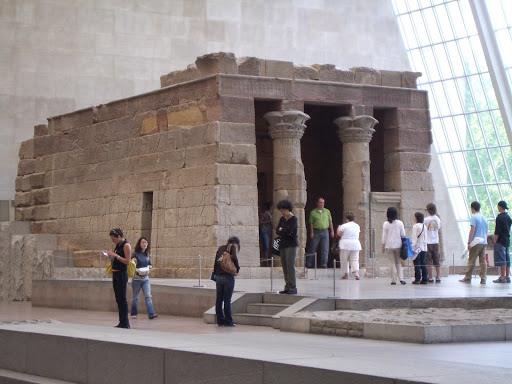
If one walks through the Egyptian collection at Met, he or she can easily get lost. There are too many terms from timeline (three major periods with three intermediate periods) to gods (names, relations, shapes, symbolism) to texts. There seems to be endless items to go through in one afternoon. On the other hand, he or she can also get confused. The block statues, to laymen’s eyes, look almost the same for 4000 years spans. The paintings, in a similar way, vary little in techniques or subjects. Who are these Egyptians behind all these civilization remains? Are they technically superior but religiously stupid? All these questions remain unanswered from those museum visit unless there is a comprehensive guide about the Egyptians themselves.

Barbara Mertz’s book “Red Land, Black Land – Daily Life in Ancient Egypt”, if not authoritative with certain existing collection (luckily it is not), brings readers vivid and complete pictures of the people that create all these wonders. It is riveting and humorous sometimes. But most importantly, it is not a book written in a rigid scholarly way that most readers fail to pass page 10 or would not bother until a certain interesting object is related to some sections. In fact, I have found it so charming that it is hard to put it down without completing reading it.

That reflects what most of the Egyptian collections books fail to please a general public. Narration of objects without elaborating the creators behind is seldom intriguing. In modern and contemporary fields, artists shine in front of their artworks. Even back to Renaissance period, those big names are well studied and understood. But in ancient Egypt, artists, architects or scribes were commoners who left no personal trace. Thus it is easy to forget to recognize them as a whole. But Barbara brings us a clear picture of a society in hierarchical steps: pharaohs, priests, officials, soldiers, artists, peasants and even prisoners. The objects created by or for these individuals thus can be explained within a richer social context.

Some passages are well written and may deal with the fundamental human feelings, needs and pleasure. Female readers may find the beginning part about the songs for the dead children or childbirth is touching. Male readers may envy the fact that beer was abundant in ancient Egypt even for the kids and they may even try to google “King Tut’s” beer that is supposedly produced by ancient technique and ingredients. (Did I say fundamental needs there?)

While the book starts from descriptions of daily life of an ordinary family, it ends in climax chapters about gods, mummies and death topics that are more related to the kings and nobles. These chapters are great introduction for further study of any particular period or object because Barbara not only tells us how the styles changed, but also clear pictures of how certain objects are made (what material, what procedure, how long, etc). The making of mummies will definitely interest a reader, but then the same reader may be disappointed by what a real “book of the dead” is. (The twisted definitions in Hollywood movies may cause Barbara to write another book!) Overall, the reading will demystify Egyptian arts and make readers clearly understand what they see in the museums are solely created by needs, desires or responsibilities.

No Egyptologist would not be stubborn about what they believe, but Barbara, who has seen controversies over most of the subjects, at least brings the readers aware of what she believes and what other interpretative possibilities. But the strength of the book can also be a little overdone when several contradictory options are presented in great length. At certain areas such as the fights between Re and Orisis, readers are left with no clear pictures of what the scenarios should be.

Do I want to experience the ancient Egyptian life? I asked myself in the end. Probably not, even if I were an Egyptologist. It is much more enjoyable to experience their life from Barbara’s book than reality.

Delicious Bookmark this on Delicious